
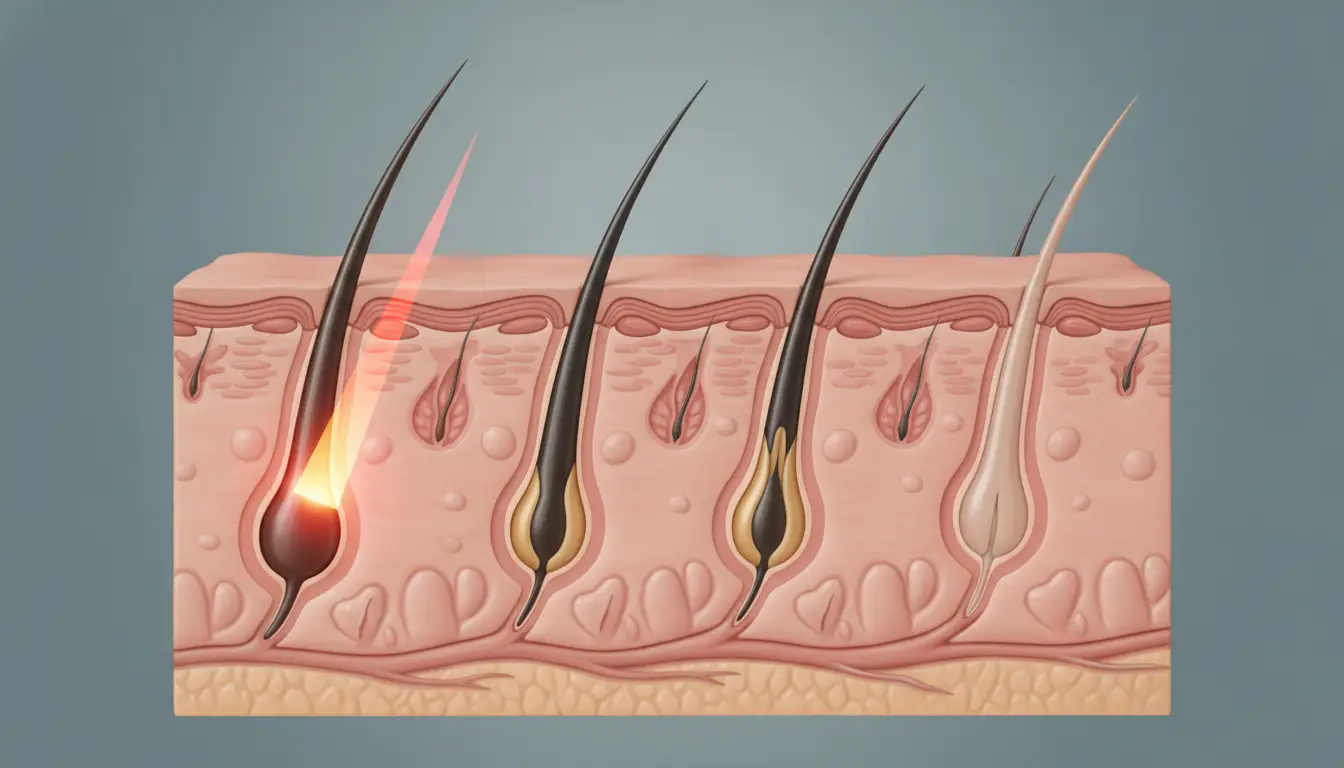
Laser hair removal does not affect every visible or developing hair equally, primarily because individual follicles operate on completely independent biological timelines. Rather than growing in unison, each follicle exists at a different stage of its lifecycle.
Understanding this underlying hair growth cycle is essential because it reveals the biological mechanics behind the procedure.
Specifically, follicle biology explains why several treatment sessions are normally required to address an area, why those sessions must be carefully spaced weeks apart, why hair may still appear between scheduled appointments, and why treatment results develop gradually over an extended period.
Understanding the Four Stages of the Hair Growth Cycle
Human hair does not grow and shed simultaneously. Instead, individual follicles move independently through a four-stage lifecycle.
Anagen — Active Growth
Anagen is the active growth stage. During this period, matrix cells within the follicle actively produce the hair shaft, and pigment production is high. Because the follicle and growing hair contain substantial melanin (pigment) during anagen, this phase is uniquely critical for light-based hair removal technologies.
Catagen — Transition
Catagen is a brief transitional phase. Hair growth slows significantly, and the lower part of the follicle begins to shrink and regress. As active growth stops, the lower follicle separates from the dermal papilla while the hair remains anchored in place.
Telogen — Rest
During the telogen phase, the follicle is resting rather than actively producing a new hair shaft. The existing hair remains dormant, but beneath it, the follicle simultaneously prepares for a new cycle.
Exogen — Shedding
Exogen is an active shedding phase where the existing hair is finally released from the skin and falls out. Because these stages occur independently across all follicles, neighboring hairs within the same anatomical area may be in completely different biological phases at any given moment.
Why Laser Hair Removal Works Best During the Anagen Phase
Laser hair removal relies on the “Extended Theory of Selective Photothermolysis,” a process where light energy is absorbed by the melanin in the hair shaft and diffused as heat to affect surrounding follicular structures.
Laser hair removal is generally most effective against pigmented hairs in the active anagen phase, when the follicle is actively growing and provides a stronger target for selective photothermolysis. Hairs in transitional or resting phases tend to respond less effectively.
Treatment effectiveness depends not only on catching the follicle at the right time but also on applying appropriate wavelengths, fluence, pulse duration, cooling, and other parameters for the individual being treated. Modern professional laser hair removal equipment may offer different wavelengths and adjustable treatment parameters according to factors such as hair characteristics and skin tone. However, appropriate device selection cannot eliminate the underlying influence of the hair growth cycle.
Why One Laser Session Cannot Treat Every Follicle
Because hair follicles are not synchronized, a single laser application cannot successfully treat an entire anatomical area simultaneously. The human body maintains a staggered growth cycle where many follicles may be resting rather than actively growing. At any given time, some hairs are actively growing, some are transitioning, some are resting, and others are shedding.
Therefore, one appointment reaches only a fraction of follicles at their most responsive stage. Successive treatments are required to give additional resting follicles an opportunity to enter active growth and become more suitable targets for the laser. Repeated sessions are primarily a consequence of normal hair biology and asynchronous follicle cycling, rather than simply repeating the exact same treatment on the exact same group of hairs.
Why Treatment Timing Changes by Body Area
The length of the hair growth cycle and the percentage of follicles in active growth vary drastically across different areas of the body. Because of these biological differences, treatment timing must be customized to the anatomical region rather than strictly following a rigid, universally correct schedule.
Practitioners typically adjust timing according to the treatment area and the appearance of new active growth. For example, facial areas may sometimes be treated at intervals of around 4 to 6 weeks, while areas such as the underarms, bikini region, torso, back, or legs may require longer intervals depending on individual regrowth patterns and treatment response.
The operational goal is to connect session spacing to follicle biology, allowing time for a new cohort of hairs to enter the anagen phase before retreatment.
Why Hair Can Appear to Grow Back Between Sessions
A common assumption is that seeing hair after a treatment automatically means the laser did not work. However, this is rarely the case. It is critical to differentiate between true treatment failure and normal biological processes.
First, treated hairs may remain visible temporarily before shedding from the skin, which can mimic the appearance of continued growth.
Second, resting follicles will naturally enter a new anagen growth phase, pushing up new hairs that were dormant during the previous session.
Third, as coarse hairs are destroyed, previously less-visible hairs may become noticeable. Finally, genuine new growth can be influenced by hormones or other physiological factors.
Because follicles become active at different times, they can create the illusion of continuous regrowth even when previously treated anagen hairs have successfully responded to the laser. While later growth often becomes finer or less dense as treatment progresses, individual biological timelines mean regrowth patterns will vary.
Other Factors That Influence Laser Hair Removal Results
While the biological cycle dictates the overall timeline, several external and physiological variables influence how well the light energy works during a specific session.
Hair Colour and Thickness
Laser technology requires melanin to act as a target. Because of this, pigment levels and hair characteristics heavily affect how strongly light energy can target the hair. Coarse, dark hair generally provides a stronger optical target, whereas blonde, grey, or vellus (fine) hair contains less melanin and therefore responds less effectively to many laser systems.
Skin Tone and Wavelength
Treatment technology and wavelength selection must account for differences in skin pigmentation to reduce the risk of thermal damage to the epidermis. Guided by factors including the Fitzpatrick scale, hair characteristics, tanning status, and treatment parameters, practitioners may use longer wavelengths such as Nd:YAG 1064 nm for darker skin because they are less strongly absorbed by epidermal melanin and penetrate more deeply. Careful adjustment of fluence, pulse duration, spot size, and cooling remains necessary.
Hormones and Genetics
Hormonal activity—such as fluctuations from pregnancy, menopause, or conditions like PCOS—and genetics heavily affect where hair grows and whether entirely new hairs develop over time.
Treatment Area and Settings
Different body areas and hair characteristics require highly customized treatment parameters. Because anatomical responses vary, no single machine, wavelength, or fixed setting is universally best for every patient or body region.
What to Expect Over a Complete Treatment Cycle
Laser hair removal is a progressive process intrinsically tied to repeated changes in follicle activity. Results must be judged across a course of multiple appropriately timed treatments rather than after one appointment, with the total number varying according to the treatment area, hair characteristics, device, and individual response.
Understanding the biological hair cycle explains why results appear gradually, why specific treatment intervals matter, why some hairs appear between sessions, and why individual results differ.
The realistic clinical objective is progressive, long-term hair reduction based on individual response, rather than a promise of complete or permanent removal for every person. Long-term maintenance may be required to manage new growth triggered by natural biological shifts.