
When people ask what hair is made of, the keratin is the honest answer. That same tough protein forms your nails and the top layer of your skin.
The rest of each strand holds water, natural oils, a little color pigment, and tiny traces of minerals.
Here is a fact that surprises most people – every strand you own is technically dead once it clears your scalp. Only the part tucked under the skin holds living cells.
Keep reading for the full structure and chemistry of hair, laid out step by step.
It is easier to grasp than it sounds.
Hair Structure From Tip to Root
Your hair really comes in two parts: the bit you can see and the bit tucked away under your scalp. Once you get how those two pieces work together, what hair is made of finally clicks.
Hair Shaft
The hair shaft is the part you actually see above your scalp.
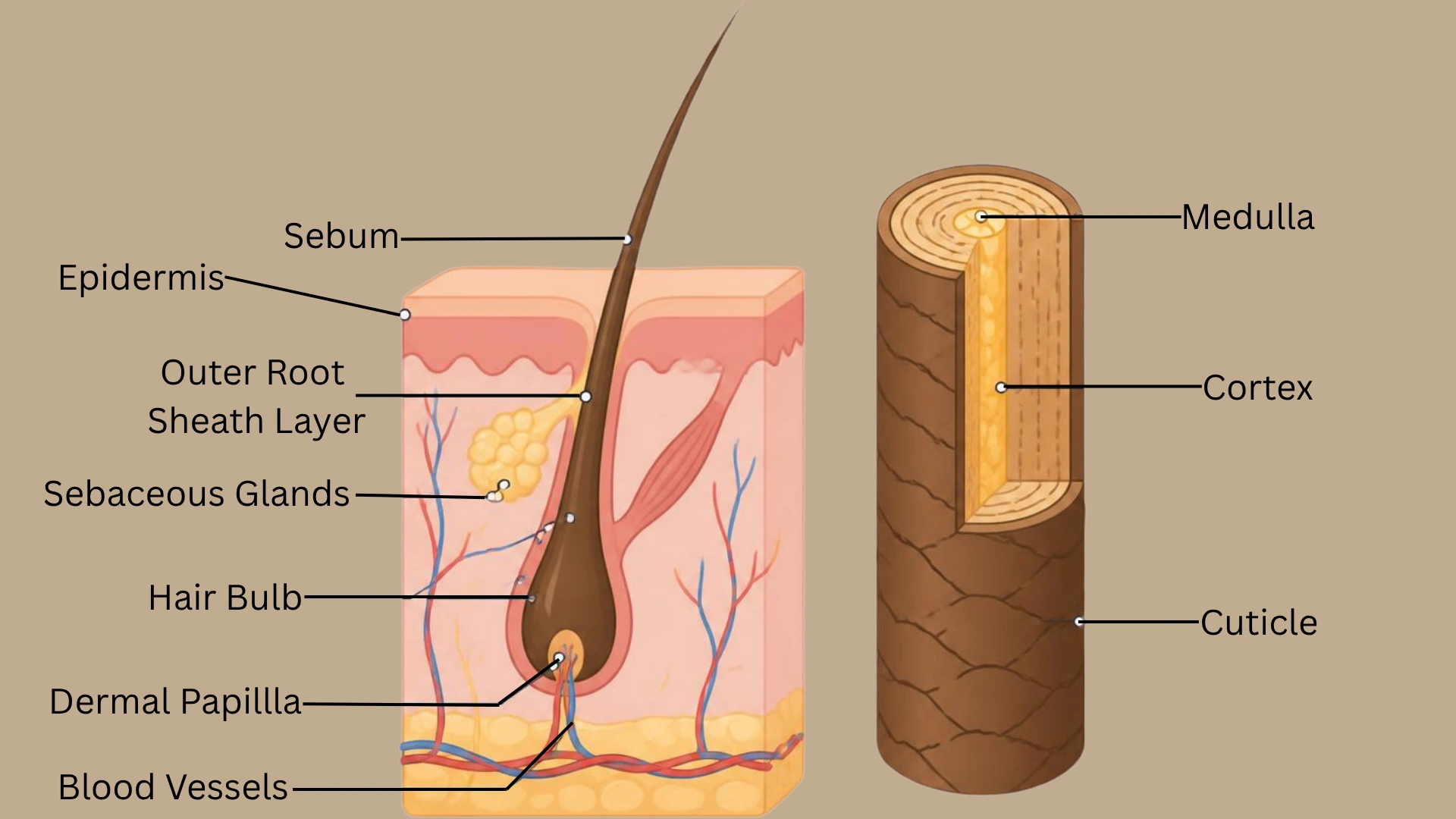
That whole visible strand is already dead, with no living cells left in it. Inside, it stacks into three layers, and each one is built from keratin.
The outer layer, the cuticle, works like armor and takes the daily wear for the rest.
Under that sits the cortex, which holds most of your hair’s strength and its color. Right in the core, you might find the medulla, though fine hair often skips it.
That layered build explains a lot about what hair is made of.
Hair Root
The hair root is the opposite of the shaft.
It is the living, hidden part sitting under your scalp. While the strand you see is dead, the root is very much alive and working.
It stays anchored inside the follicle, deep in the skin layer called the dermis. Down at the bottom, actively dividing cells keep pumping out new hair cells.
As those cells fill with keratin and harden, they get pushed upward into the shaft.
A nearby blood supply feeds the root with oxygen and nutrients. That steady feed is what hair is really made from before it ever surfaces.
This dead-tip, living-root split is exactly why a haircut never hurts.
Hair Follicle
The hair follicle is the tube that holds each strand in place. It reaches down from the surface of your skin into the dermis below.
Think of it as a small sack that surrounds and protects the root. The follicle also decides your hair’s shape, so a round one grows straight hair and an oval one grows curls.
Attached to it sits a tiny oil gland that keeps the strand soft.
Around 85 to 90% of your scalp follicles are actively growing at any time. That busy little tube shapes a big part of what your hair becomes.
Your body holds around 5 million hair follicles, yet only about 2% of them sit on your scalp.
Hair Bulb
The hair bulb is the swollen base at the very bottom of the root. This is where all the real growth happens.
It holds fast-dividing cells called the matrix, the actual factory of your hair. These cells split quickly, harden with keratin, and build each new strand from the ground up.
Pigment cells here, called melanocytes, also decide your natural color. So both your hair’s growth and its shade start inside this one small spot.
Without a healthy bulb, no new hair can form at all.
Dermal Papilla
The dermal papilla sits right at the base of the bulb, wrapped by those growing cells. It is a small, cone-shaped structure packed with tiny blood vessels.
Its main job is delivery, feeding the bulb oxygen and nutrients through that blood supply.
This steady feed fuels the active growth phase of every strand. The papilla also reacts to hormones, which is why it plays a role in pattern hair loss.
For its size, it holds real sway over how well your hair grows.
Understanding the Hair Cortex and Other Hair Layers
Now that the root side is clear, let us head back up to the shaft.
Those three layers mentioned earlier deserve a proper look, because the hair cortex and its neighbors decide how your hair really behaves.
Hair Cuticle
The hair cuticle is the outermost layer of every strand. It works as a shield for the softer layers underneath.
Picture roof tiles or fish scales, since the cuticle is made of flat cells that overlap in the same way.
When these scales lie smooth and flat, your hair looks shiny and healthy. When they lift or crack, hair turns dull, rough, and prone to breakage.
This layer takes the hit from heat, brushing, and coloring so the inner layers stay safer. Hairdressers often say cuticle health is the real secret behind glossy hair.
Protecting it matters, because a strong cuticle keeps the cortex below it safe and sound.
Hair Cortex
This is the middle, thick layer that does most of the hard work.
It is located immediately beneath the cuticle and comprises the major portion of each individual hair strand. Here is where your hair acquires all its strength, elasticity, and pigmentation.
Thick bundles of keratin are packed together due to tough chemical bonds in the hair cortex, which are broken during damage caused by styling devices and hair bleaching.
The amount of melanin in it determines whether you have dark or fair hair, or anything in between.
Hair Medulla
The hair medulla is the soft core hiding in the very center. Honestly, it is the layer scientists know the least about.
It is a loose, spongy channel of cells and air spaces.
Thick or coarse hair usually has one, while fine hair often skips it completely. Because of that, its exact job stays a bit of a mystery.
Most experts think it adds a little bulk to thicker strands. You can have perfectly healthy hair whether yours has a medulla or not.
Hair Cuticle vs Cortex vs Medulla: What Each Layer Does
| Layer | Purpose | Importance |
| Cuticle | Shields the inner layers as the tough outer coat | Keeps hair shiny and smooth, and guards against damage |
| Cortex | Holds keratin bundles, strength, stretch, and color | Decides how strong your hair is and what shade it shows |
| Medulla | Sits as the soft, hollow core at the center | Adds slight bulk to thick hair, though often absent in fine hair |
What Chemicals and Proteins Make up Hair
When you break a single strand down to its chemistry, the ingredient list is shorter than you might expect.
Your hair is mostly keratin protein, with water, natural fats, pigment, and a few trace minerals filling out the rest. That small handful of ingredients is honestly all it takes to explain what hair is made of.
Keratin Proteins
Keratin is the headline ingredient by a mile. It makes up somewhere between 65% and 95% of your hair’s weight.
This tough protein is built from long chains of amino acids linked together. One amino acid, cysteine, forms strong sulfur bonds that give hair its strength and shape.
Those same bonds are what a perm or relaxer breaks and resets. So this one protein really carries most of the load.
The same keratin in your hair also builds animal horns, hooves, and feathers. That shared protein is why hair holds up so well.
Water Content
Water is the quiet second ingredient people always forget. Around 12% to 15% of each strand is simply water.
It acts like a softener, keeping hair flexible instead of stiff and snappy.
Dry weather pulls water out, which is why hair feels brittle in winter. Humid air adds it back, which is why curls swell and frizz.
That shifting water level explains a lot of your daily hair mood.
This is why the same head of hair behaves so differently in summer and winter. Water moves in and out with the air around it.
Natural Lipids
Lipids are the natural fats woven through your hair. They include fatty acids, cholesterol, and oils mostly drawn from sebum.
Your scalp makes sebum, which coats each strand and locks moisture in. These fats also help hold the cuticle cells together tightly. When lipids run low, hair turns dry, dull, and harder to manage.
A healthy fat layer is a big part of soft, glossy hair.
Strip these fats with harsh washing and hair loses its shine fast. They are the built-in conditioner your scalp makes.
Melanin Pigments
Melanin is the pigment that gives your hair its color. It comes in two forms that mix to create every shade.
Eumelanin brings black and brown tones to the strand. Pheomelanin adds red and yellow tones instead.
The blend you inherit decides whether you are dark, fair, or ginger. As melanin production slows with age, hair loses color and turns grey.
A single strand keeps the same colour for its whole life. Greying happens strand by strand, as new ones grow in without pigment.
Trace Minerals
Trace minerals are the smallest piece of the whole picture.
Hair holds tiny amounts of zinc, iron, and copper. These metals support the protein systems that keep hair growing well.
Because hair stores them, a strand can even hint at your nutrition. Low iron, for example, often shows up as weaker, thinner hair.
Small as they are, these minerals still pull real weight.
It is because of these Trace Minerals that a lab can test a single strand and read months of your diet, stress, and even toxin exposure.
Conclusion
So the next time you run a brush through your hair, you know exactly what you are handling.
Most of it is keratin, padded out with water, natural oils, color pigment, and a pinch of minerals. The living root does all the work below, while the strand on top simply carries the results.
Simple ingredients, but they shape everything about how your hair looks and feels.
Frequently Asked Questions (FAQs)
1. Does Hair Composition Differ Between People?
The basic mix stays the same for everyone. Small things like pigment amount and mineral content shift with genes and diet.
2. Why Does Hair Turn Grey with Age?
Grey appears when pigment cells slow down and stop making melanin. Less melanin means less color, so strands look grey or white.
3. How Strong Is a Single Strand of Hair?
One healthy strand can hold about 100 grams. A full head could, in theory, support the weight of two elephants.