


Many people are embarrassed by a M hairline and think it needs fixing. And it was my case too.
Barbers would look at my temples and quietly suggest treatments. But nobody told me that the M hairline isn’t always a warning sign.
In fact, for a lot of men, it’s just how their hair naturally grows.
Let me break down everything about the M shaped hairline, whether it’s good or not, and what you can do if yours is changing.
What is the M Type of Hairline?
The M-type hairline is a hair pattern where hair recedes at the temples while the center remains fuller, creating an “M” shape. This occurs when hair follicles at the temples become sensitive to DHT (dihydrotestosterone), causing hair miniaturization and loss in those areas.
This genetically determined pattern commonly develops in men between ages 17-29 as part of normal hairline maturation.
The M-type hairline can be either a stable, mature hairline that stops progressing after 1-2 cm of recession.
Early-stage male pattern baldness that continues advancing with further recession, hair thinning, and potential crown involvement.
Management options include styling techniques, topical minoxidil for maintenance, oral finasteride to block DHT, or hair transplant procedures for permanent restoration.
Is it a Good Hairline or a Warning Sign?
A mature M shaped hairline can be perfectly normal and balanced- not a cause for concern. Many men have this natural pattern their whole lives without further hair loss.
However, watch for warning signs like a gradually deepening M shape or thinning in other areas.
These changes may signal early balding that needs attention from a hair specialist.
Different variations in men and women
Men typically show more pronounced M shapes with deeper temple recession.
Women often have subtler M patterns that look softer and less defined.
When you notice women’s M hairlines usually maintain more hair density at the temples. Men’s versions tend to progress more dramatically over time with age.
How age and hair type influence the look
Younger people might have subtle M shapes that become clearer with time.
Thick hair can hide the pattern while thin hair makes it more obvious. Curly hair mask M hairlines better than straight hair.
Age makes the temples recede more, creating a sharper M appearance over the years.
What Causes an M-Shaped Hairline?
Why does someone develop an M-shaped hairline? It’s usually a mix of biology, hormones, and lifestyle.
Genetics and Hereditary Factors
How it Affects Men
Genetics is the primary factor in shaping men’s hairlines, and the gene responsible is inherited from both parents.
If the men in your family have M-shaped or receding hairlines, be aware that your own hairline is likely to follow the same inherited blueprint.
How it Affects Women
Women inherit hairline patterns, too.
A woman with a genetic predisposition might notice a slightly wider forehead or mild temple thinning rather than a dramatic M hairline.
Hormonal Changes
How it Affects Men
Dihydrotestosterone, or DHT, is the hormone most linked to hairline changes in men.
When DHT levels rise, hair follicles along the temples can shrink over time, gradually pulling the hairline into that M shape.
M-shaped hairlines begin to appear during puberty or early adulthood, when hormone levels are shifting.
How it Affects Women
Hormonal fluctuations and women go hand in hand, from puberty to pregnancy, postpartum, and menopause.
During these periods, estrogen levels drop, and androgen activity can increase, which sometimes leads to temple recession or a more defined M shape.
Did you know? Polycystic ovary syndrome (PCOS) is another hormonal condition that can trigger similar hairline changes.
The Natural Maturing Process
How it Affects Men
Not every M shaped hairline indicates hair loss.
Many men experience a maturing hairline in their late teens to mid-twenties, where it moves back slightly and often takes on an M shape.
How it Affects Women
Women also experience a natural shift in hairline with age; though it’s less often discussed, the hairline may gradually widen or soften at the temples.
This isn’t necessarily a sign of androgenic alopecia, it can simply be the hairline settling into its adult form.
Traction and Hairstyle Damage
How it Affects Men
Men who wear tight hairstyles like man buns, cornrows, or tight braids, it can develop traction alopecia.
The constant pulling stress on the temples weakens the follicles over time, which can create or worsen an M-shaped appearance.
How it Affects Women
Women are actually more at risk here with tight ponytails, weaves, extensions, and braided styles, which are a leading cause of traction alopecia in women.
If caught early enough, this type of hairline change is often reversible.
Stress and Lifestyle Factors
How it Affects Men
Chronic stress can cause hair follicles to enter a resting phase, a condition called telogen effluvium.
In men, this often first appears at the temples, making the M shape more prominent.
Poor sleep, crash dieting, and nutritional deficiencies like low iron or vitamin D can all accelerate this process.
How it Affects Women
Women are more susceptible to stress-related hair loss than men.
Temple thinning from stress is common in women, especially after major life events like childbirth, illness, or prolonged emotional stress.
A balanced diet and stress management make a difference.
How Minoxidil and Finasteride Help You?
Minoxidil works by increasing blood flow to your hair follicles and stimulating growth. Apply it directly to your scalp twice daily for the best results in slowing temple recession.
Finasteride blocks the DHT hormone that causes hair follicles to shrink. Take this oral medication daily to prevent further hair loss and maintain your current hairline pattern.
Disclaimer: Minoxidil works better as a maintenance tool than a regrowth solution, especially if recession has been going on for years.
Can You Reverse Your M-Shaped Hairline?
If your M shaped hairline is the result of a naturally maturing hairline, there’s nothing to reverse; it’s just your hair settling into its adult pattern.
However, if thinning is caused by stress, poor nutrition, or traction damage, there’s a real chance of improvement.
Treatments such as minoxidil and DHT-blocking shampoos have shown results for many people.
But just know the sooner you identify what’s changing everything, the better your chances of holding onto or recovering your hairline.
Is M Hairline and Receding Hairline the Same?
This is one of the most common questions I get, and the confusion makes complete sense.
They look similar, but they aren’t the same thing.
M-shaped Hairline
It can simply be the natural shape of your hairline.
Some people are born with it or develop it during their maturing years without any further progression.
Don’t worry, it can be a shape, not necessarily a symptom.
Receding Hairline
It’s actively pulling back from where it once was. The temples thin, the forehead grows larger over time, and the change is ongoing.
A receding hairline often takes on an M shape as it progresses. So the two can overlap.
The difference is whether your hairline is stable or changing.
Know by taking photos of your hairline every few months. If the shape stays consistent, you likely just have an M-shaped hairline, but if the temples are creeping back, that’s recession.
M-Shaped Hairline vs Other Hairlines
Not all hairlines are the same. Let me show you how M hairlines differ from other common patterns so you can identify yours correctly.
| Hairline Type | Shape & Appearance | Common Causes |
|---|---|---|
| Straight Hairline | Even line across the forehead with no visible recession at the temples. | Often genetic |
| Widow’s Peak | Distinct V-shape at the center of the forehead, hairline slopes back on both sides. | Mostly genetic |
| M Hairline | Recession at both temples with hair remaining lower in the middle, forming the letter “M.” | It can be genetic, age-related, or linked to early male-pattern hair loss. |
Now you can easily spot the differences between these hairline types and understand what’s normal for your hair pattern.
Best Haircuts that Suit M-Hairline
The right haircut can completely change how your M-shaped hairline looks.
The styles below don’t hide your hairline; instead, they frame it.
Caesar Cut

This style keeps hair short all around, with slightly longer hair on top that’s combed forward to cover your temples naturally, making the M pattern less noticeable.
It’s clean, low-maintenance, and works well for most face shapes.
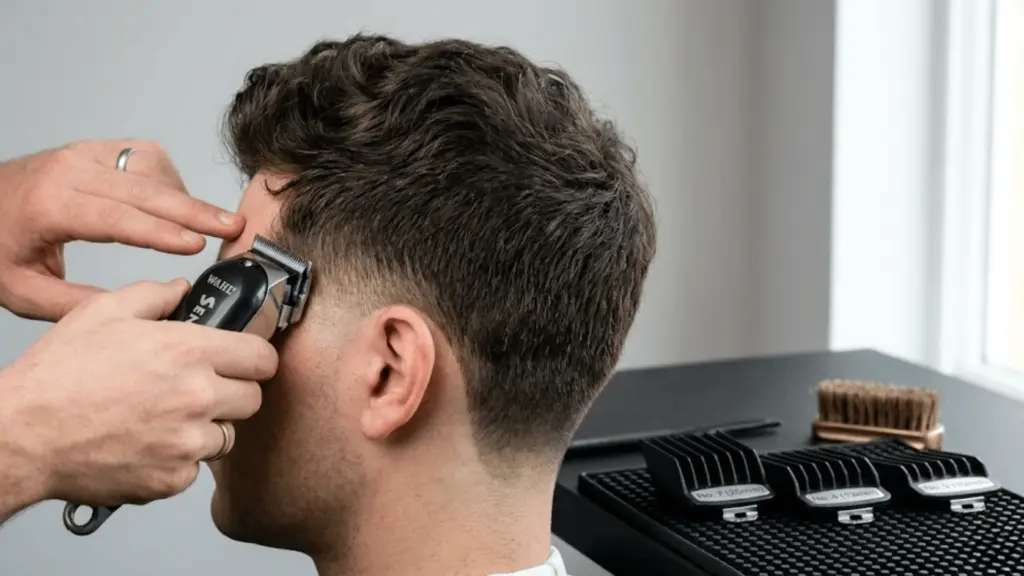
Style tip: Ask your barber for a slight skin fade on the sides, as it adds definition and make it look sharper.
Buzz Cut

By keeping everything short, you eliminate the contrast that makes an M-shaped hairline stand out in the first place.
It’s bold, confident, effortless, and requires almost zero styling time.
Style tip: A number 2 or 3 on top with a slight fade on the sides gives the buzz cut a modern finish.
Curtain Cut

The curtain cut features longer hair in the middle that parts naturally and falls to both sides, softening the M shape by creating gentle layers that flow over the temples.
The natural movement and texture help disguise recession while keeping things modern and relaxed.
And it’s trending now.
Pompadour

The pompadour creates height and volume on top, making your M hairline look intentional and fashionable.
Modern pompadours work well because they highlight your hair’s strengths.
Style tip: Use a medium-hold matte-finish pomade for a modern look; avoid heavy grease.
Improving Hairline Health
Let me share the most effective routines that actually work for improving hairline health.
- Taking care of your scalp and hair can improve the appearance of your M hairline over time.
- Scalp massages increase blood flow to hair follicles, which promotes healthier growth at the temples.
- Focus on nutrition rich in vitamins and iron – your hair needs these nutrients to stay strong. Eat plenty of leafy greens, lean proteins, and foods with biotin and vitamin D.
- Avoid tight styling practices, such as harshly pulling hair back or using elastic bands that create tension.
Bottom Line
I’ve spent way too long seeing my M-shaped hairline as a problem to be solved.
The M hairline isn’t the enemy. For many people, it’s simply genetics, a natural part of growing up, or just the shape they were born with.
Yes, sometimes it signals a change worth addressing, but even then, you have options.
Your hairline doesn’t define your look, but how you own it does.
Let me know in the comments how you dealt with your M shaped hairline.
Frequently Asked Questions (FAQs)
1. Is an M-Shaped Hairline Attractive?
Yes, many people find it attractive. It gives the face a strong, defined frame. Confidence in how you carry it matters.
2. Which Hairline is Attractive?
Straight, rounded, and M-shaped hairlines can all look great depending on face shape, grooming habits, and personal style.
3. Which Organ is Linked to Hair Loss?
The scalp’s hair follicles. Also, poor liver function can disrupt hormone balance, leading to excess DHT and hair thinning.
4. Why is Gen Z Losing Hair?
A mix of chronic stress, poor diet, excessive heat styling, and screen-driven sleep disruption.